Architecture
Lens is a three-tier system: a browser single-page app, an application layer that serves the UI and brokers API traffic, and a control plane that owns the domain logic, access control, persistence, Kubernetes access, and the model-service control plane. The same control plane provisions and reconciles the model-service data plane, while model inference traffic flows through a shared gateway rather than the browser API paths.
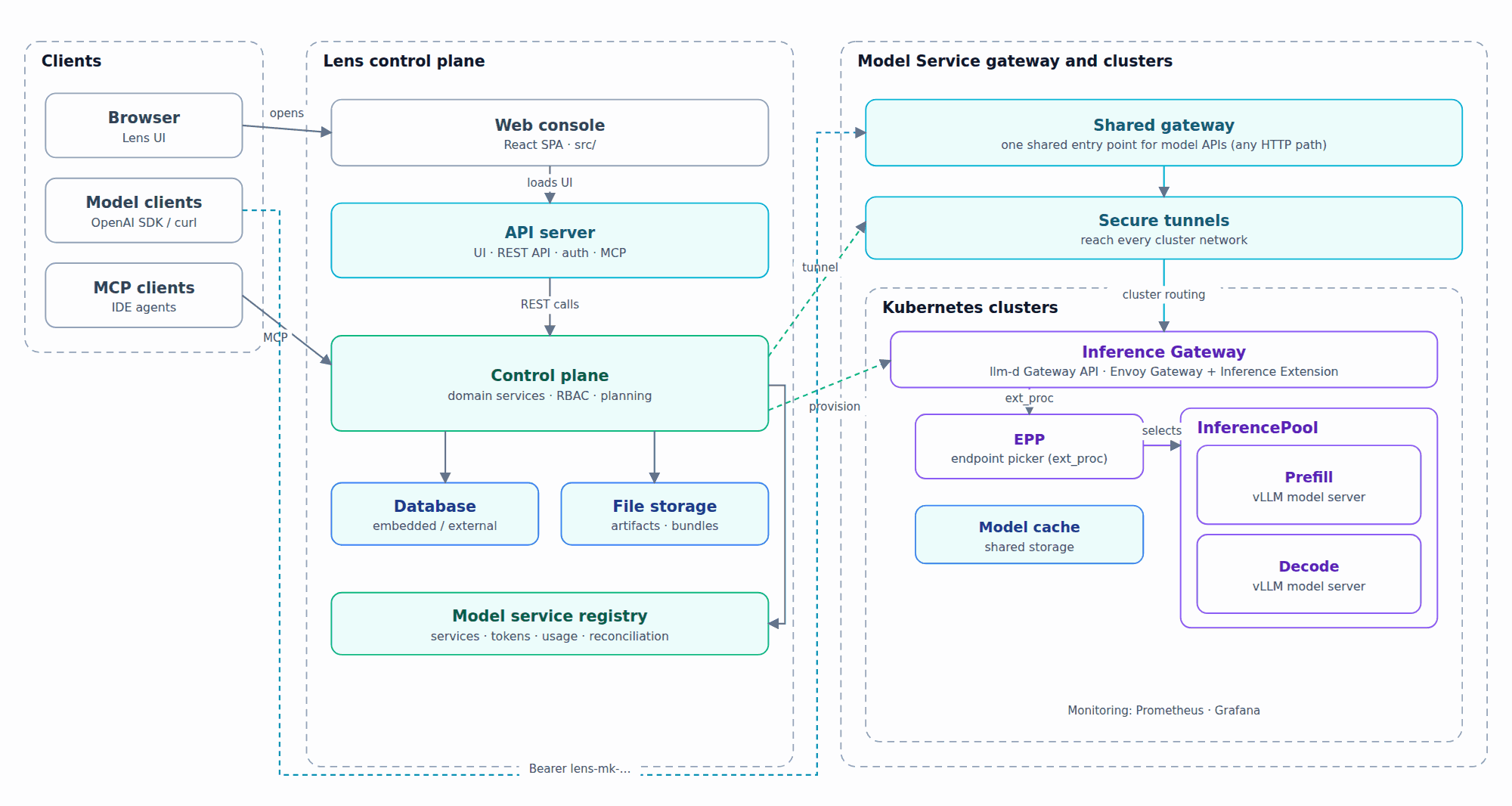
Layers
| Layer | Responsibility |
|---|---|
| Clients | Browsers using the Lens console, OpenAI-compatible model clients, and MCP clients such as IDE agents. |
| Application layer | Serves the web console, resolves the signed-in user, applies route-level authorization, brokers API traffic to the control plane, and hosts the stateless MCP endpoint. |
| Control plane | Owns domain services, access control and cluster scoping, persistence, file and artifact storage, cluster operations, deployment planning, and the model-service control plane. |
| Data plane | A cluster-shared llm-d Gateway (provider-selectable at cluster creation) plus a per-model HTTPRoute/IPP; each deployment owns an InferencePool + EPP and the vLLM replicas. |
| Storage | A relational database for application state, and file storage for artifacts and deployment bundles. |
Request flow
- The browser calls a same-origin Lens endpoint.
- The application layer resolves the caller's session, strips spoofable headers, enforces any route-level permissions it owns, and forwards API calls to the control plane with the caller's identity.
- The control plane re-resolves the caller, checks the permission the route requires, and rejects unauthenticated, unauthorized, or CSRF-failing requests.
- A matched domain service handles the request, reads or writes the database, touches file storage when needed, and uses cluster access to act on Kubernetes.
- Cluster-scoped resources are narrowed to the clusters the caller can reach, or writes are rejected outright.
- Model inference is a separate path: clients call the shared gateway with a gateway token, which authorizes the request, selects a target, and forwards it to the right cluster and deployment.
Access model
Access is modeled around a principal with role bindings at global, cluster, or resource scope. A global admin reaches every cluster; a cluster-scoped maintainer reaches only the clusters granted to them. Requests are denied by default, each route maps to a required permission, and the same scoping is applied consistently across domains, so listing, publishing, usage reporting, and gateway operations stay within the caller's reachable clusters.
Deployment planning
Agentic deployment planning is a deploy-time, retrieval-augmented recommendation step rather than a runtime scheduler. It validates a request, gathers live cluster facts, and retrieves supporting evidence from capacity estimates, prior deployments, completed simulations, and benchmark results. It then ranks only validated candidates and stores a recommendation; nothing is deployed until a person approves it.
For design details, see Agentic deployment for the planner and approval flow, and Planning evidence and RAG for evidence sources and retrieval.
Model service gateway
The model service gateway publishes cluster deployments as OpenAI-compatible services behind the cluster's shared llm-d Gateway. The control plane manages services, providers, tokens, and usage, and installs the shared Gateway at cluster creation; the Gateway authorizes each request and routes it to the model service's InferencePool, whose Endpoint Picker selects the endpoint. Deployments keep their own InferencePool + EPP but run no proxy.
Related
- Clusters, Deployments, and Model services
- Administration for roles and scopes
- MCP integration